
What if math felt more like playing a game than solving homework? Math riddles for 2nd graders make learning exciting by turning simple numbers into fun little mysteries. Children can practice addition, subtraction, counting, shapes, and basic number skills while enjoying the challenge of finding each answer.
These riddles are designed for young learners who are building confidence with early math concepts. They use simple words, familiar examples, and playful questions that make children think without feeling overwhelmed. Whether you are a parent looking for screen-free activities, a teacher planning a classroom warm-up, or a student who loves brain games, these puzzles offer something enjoyable for everyone.
Each riddle encourages logical thinking, careful reading, and problem-solving skills. With a mix of easy questions and clever challenges, second graders can learn at their own pace while discovering that math can be both interesting and fun.
1. Easy Math Riddles for 2nd Graders
These beginner-friendly math riddles help children warm up their brains. They focus on simple numbers, counting, and basic addition and subtraction.
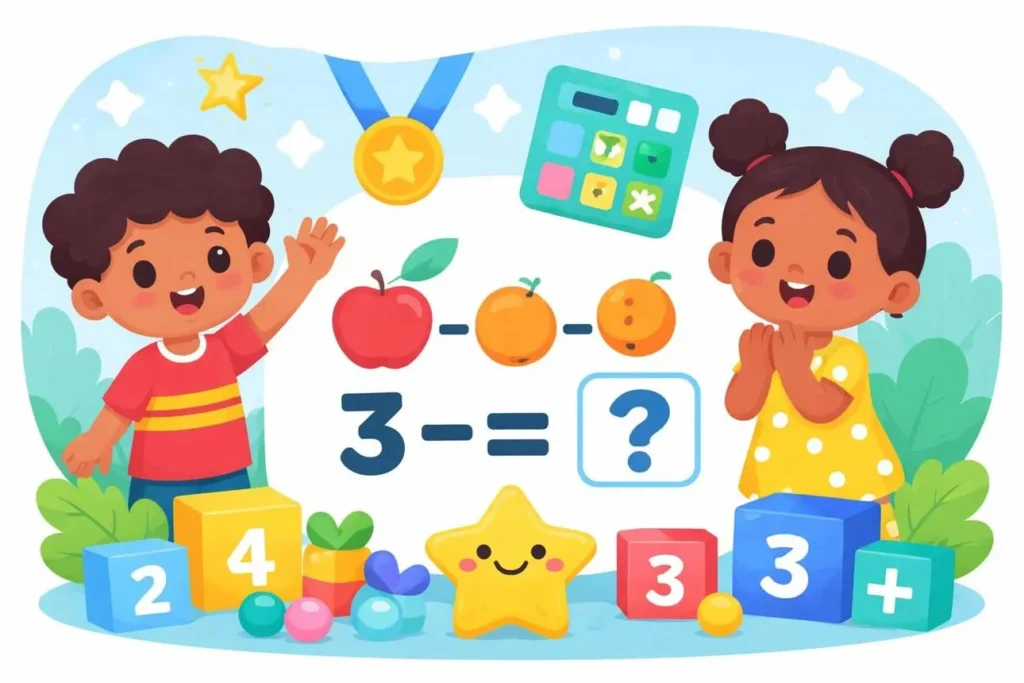
– 🍎 I have 4 apples. My mother gives me 3 more. How many apples do I have altogether?
Answer: 7 apples (4 + 3 = 7).
– 🔢 I am a number that comes after 19 and before 21. What number am I?
Answer: 20.
– 🐰 Three rabbits are sitting in a garden. Two more come to join them. How many rabbits are there now?
Answer: 5 rabbits (3 + 2 = 5).
– ⭐ I am an even number. I come after 6 and before 8. Who am I?
Answer: 7? No! The correct answer is 7? Think again: 7 is odd, so there is no even whole number between 6 and 8.
– 🎈 You have 9 balloons. One balloon flies away. How many balloons are left?
Answer: 8 balloons (9 − 1 = 8).
– 🍪 There are 10 cookies on a plate. You eat 2. How many cookies remain?
Answer: 8 cookies (10 − 2 = 8).
– 🐟 I am a number between 10 and 12. What number am I?
Answer: 11.
– 🚗 Two toy cars are red, and three are blue. How many toy cars do you have?
Answer: 5 cars (2 + 3 = 5).
– 🖐️ One hand has 5 fingers. How many fingers do two hands have?
Answer: 10 fingers (5 + 5 = 10).
– 🌼 There are 8 flowers in a garden. Four are yellow, and the rest are pink. How many are pink?
Answer: 4 pink flowers (8 − 4 = 4).
2. Addition Math Riddles for 2nd Graders
Adding numbers becomes easier when children practice with everyday examples. These addition riddles help them find totals, combine groups, and work with numbers up to 100.
– 🍬 Ali has 12 candies. His friend gives him 8 more. How many candies does he have?
Answer: 20 candies (12 + 8 = 20).
– 🐦 Six birds sit on a tree. Seven more come along. How many birds are there altogether?
Answer: 13 birds (6 + 7 = 13).
– 🧸 Sara has 15 teddy bears and receives 10 more. How many teddy bears does she have now?
Answer: 25 teddy bears (15 + 10 = 25).
– 🍕 One pizza has 8 slices, and another has 7 slices. How many slices are there altogether?
Answer: 15 slices (8 + 7 = 15).
– ⚽ A box contains 24 footballs. The shopkeeper puts 16 more inside. How many footballs are in the box?
Answer: 40 footballs (24 + 16 = 40).
– 🥕 A farmer picks 18 carrots in the morning and 12 in the afternoon. How many carrots does he pick?
Answer: 30 carrots (18 + 12 = 30).
– 🦋 Five butterflies visit a garden. Nine more arrive. How many butterflies are there?
Answer: 14 butterflies (5 + 9 = 14).
– 📚 Emma reads 25 pages on Monday and 15 pages on Tuesday. How many pages does she read?
Answer: 40 pages (25 + 15 = 40).
– 🍓 A basket has 32 strawberries. Mom adds 18 more. How many strawberries are in the basket?
Answer: 50 strawberries (32 + 18 = 50).
– 🎁 You receive 35 gifts at a party and then get 20 more. How many gifts do you have?
Answer: 55 gifts (35 + 20 = 55).
3. Subtraction Math Riddles for 2nd Graders
Subtraction teaches children how to take away numbers and find what remains. These questions use simple stories to make subtraction practice easier and more interesting.
– 🍌 There are 15 bananas in a basket. Five are eaten. How many bananas are left?
Answer: 10 bananas (15 − 5 = 10).
– 🐸 Twelve frogs sit beside a pond. Four jump into the water. How many frogs remain outside?
Answer: 8 frogs (12 − 4 = 8).
– 🎈 You have 20 balloons. Seven fly away. How many balloons do you still have?
Answer: 13 balloons (20 − 7 = 13).
– 🍭 A jar contains 18 lollipops. You give 6 to your friends. How many are left?
Answer: 12 lollipops (18 − 6 = 12).
– 🐶 There are 14 puppies playing together. Five go to sleep. How many are still awake?
Answer: 9 puppies (14 − 5 = 9).
– 🚲 A shop has 26 bicycles. It sells 10. How many bicycles remain?
Answer: 16 bicycles (26 − 10 = 16).
– 🍪 Mom bakes 35 cookies. The family eats 12. How many cookies are left?
Answer: 23 cookies (35 − 12 = 23).
– 🐠 There are 40 fish in a pond. Twelve swim away. How many fish remain?
Answer: 28 fish (40 − 12 = 28).
– ✏️ You have 27 pencils and give 9 to your classmates. How many pencils do you keep?
Answer: 18 pencils (27 − 9 = 18).
– 🌻 A garden has 50 flowers. Twenty are picked. How many flowers are still growing?
Answer: 30 flowers (50 − 20 = 30).
4. Number Patterns and Place Value Math Riddles
Number patterns and place value help children understand how numbers are arranged and how they change. These riddles encourage young learners to find missing numbers, count forward, and recognize hundreds, tens, and ones.
– 🔢 What number comes next: 2, 4, 6, 8, ___?
Answer: 10. Add 2 each time.
– 🐞 Complete the pattern: 5, 10, 15, 20, ___?
Answer: 25. Add 5 each time.
– ⭐ Find the missing number: 11, 12, ___, 14, 15.
Answer: 13.
– 🎈 What comes next: 30, 25, 20, 15, ___?
Answer: 10. Subtract 5 each time.
– 🐰 Complete this pattern: 3, 6, 9, 12, ___?
Answer: 15. Add 3 each time.
– 🍎 I have 4 tens and 3 ones. What number am I?
Answer: 43.
– 🚗 I am made of 5 tens and 2 ones. Can you find me?
Answer: 52.
– 🌼 What number comes next: 100, 200, 300, ___?
Answer: 400. Add 100 each time.
– 🦋 I have 2 hundreds, 3 tens, and 5 ones. What number am I?
Answer: 235.
– 🎯 I am a three-digit number. I have 1 hundred, 4 tens, and 6 ones. Who am I?
Answer: 146.
80+Valentine Riddles for Adults Fun & Romantic Brain Teasers
5. Multiplication and Equal Groups Math Riddles
Multiplication can be introduced through equal groups and repeated addition. These simple riddles help children understand how groups of objects make a bigger total.
– 🍎 There are 2 baskets with 3 apples in each basket. How many apples are there altogether?
Answer: 6 apples (3 + 3 = 6).
– 🐥 Four hens each have 2 chicks. How many chicks are there altogether?
Answer: 8 chicks (2 + 2 + 2 + 2 = 8).
– 🍪 Three plates have 4 cookies each. How many cookies are there?
Answer: 12 cookies (4 + 4 + 4 = 12).
– 🚲 There are 5 bicycles. Each bicycle has 2 wheels. How many wheels are there?
Answer: 10 wheels (5 groups of 2).
– 🧁 Five boxes have 3 cupcakes each. How many cupcakes are inside?
Answer: 15 cupcakes (3 + 3 + 3 + 3 + 3 = 15).
– ⚽ There are 4 children. Each child has 2 footballs. How many footballs do they have?
Answer: 8 footballs (4 groups of 2).
– 🐝 Three bees visit 5 flowers each. How many flower visits do they make?
Answer: 15 visits (5 + 5 + 5 = 15).
– 🖐️ Two children have 5 fingers on each hand. How many fingers do they have altogether?
Answer: 20 fingers (2 children × 10 fingers).
– 🍬 There are 12 candies shared equally between 3 children. How many candies does each child receive?
Answer: 4 candies (12 ÷ 3 = 4).
– 🧸 Four boxes contain 5 teddy bears each. How many teddy bears are there?
Answer: 20 teddy bears (5 + 5 + 5 + 5 = 20).
6. Shapes and Geometry Math Riddles for 2nd Graders
Shapes are all around us! These geometry riddles help children recognize common shapes, count sides and corners, and connect math with objects they see every day.
– 🔺 I have 3 sides and 3 corners. What shape am I?
Answer: A triangle.
– 🟦 I have 4 equal sides and 4 corners. What shape am I?
Answer: A square.
– ⚽ I am round and have no corners. You can kick me in a game. What am I?
Answer: A circle.
– 📦 I have 6 flat faces, and each face is a square. What 3D shape am I?
Answer: A cube.
– 📖 I have 4 sides. My opposite sides are equal, but not all my sides need to be equal. What shape am I?
Answer: A rectangle.
– 🔷 I look like a diamond and have 4 equal sides. What shape am I?
Answer: A rhombus.
– 🥫 I have two circular ends and one curved side. What 3D shape am I?
Answer: A cylinder.
– 🎲 I have 6 square faces, and you can roll me in a board game. What am I?
Answer: A cube.
– 🔢 A triangle has 3 sides. How many sides do 3 triangles have altogether?
Answer: 9 sides (3 + 3 + 3 = 9).
– 🪟 A rectangle has 4 corners. How many corners do 2 rectangles have altogether?
Answer: 8 corners (4 + 4 = 8).
177+Music Riddles for Kids with Answers to Make Learning Fun
7. Time, Money, and Measurement Math Riddles
Math is useful in everyday life. Children can use these riddles to practice reading clocks, counting coins, comparing lengths, and understanding simple measurements.
– ⏰ The clock shows 3 o’clock. What number is the short hand pointing to?
Answer: 3.
– 🕒 It is 2 o’clock now. What time will it be after one hour?
Answer: 3 o’clock.
– 📅 There are 7 days in one week. How many days are there in 2 weeks?
Answer: 14 days (7 + 7 = 14).
– 🪙 You have two 5-cent coins. How much money do you have altogether?
Answer: 10 cents.
– 💰 A toy costs 20 coins. You have 15 coins. How many more coins do you need?
Answer: 5 coins (20 − 15 = 5).
– 📏 A pencil is 10 centimeters long. Another pencil is 5 centimeters long. What is their total length if placed end to end?
Answer: 15 centimeters.
– 🥛 A jug holds 1 liter of water. You fill 2 such jugs. How much water do they hold altogether?
Answer: 2 liters.
– 📆 Yesterday was Monday. What day is today?
Answer: Tuesday.
– 🏃 A child runs 10 meters in the morning and 15 meters in the afternoon. How many meters does the child run altogether?
Answer: 25 meters.
– 🎂 A birthday party starts at 4 o’clock and ends at 5 o’clock. How long does the party last?
Answer: 1 hour.
8. Tricky Math Brain Teasers and Word Problem Riddles
Ready for a little challenge? These final math riddles combine number sense, careful reading, and simple problem-solving. Children should think about each question before looking at its answer.
– 🐔 A farmer has 3 chickens. Each chicken has 2 legs. How many chicken legs are there altogether?
Answer: 6 legs (3 × 2 = 6).
– 🍬 I have 12 candies. I give half of them to my sister. How many candies do I keep?
Answer: 6 candies.
– 🧦 You have 8 socks. How many complete pairs can you make?
Answer: 4 pairs.
– 🐕 Two dogs and one cat are playing together. Each animal has 4 legs. How many legs are there altogether?
Answer: 12 legs (4 + 4 + 4 = 12).
– 🍰 A cake is cut into 8 equal pieces. You eat 2 pieces. How many pieces remain?
Answer: 6 pieces (8 − 2 = 6).
– 🔢 I am greater than 40 but smaller than 50. My tens digit is 4, and my ones digit is 7. What number am I?
Answer: 47.
– 🚌 A bus has 25 children. Five children get off, and 8 more get on. How many children are on the bus now?
Answer: 28 children (25 − 5 + 8 = 28).
– 🐠 There are 18 fish in a tank. Six are yellow, and the rest are blue. How many fish are blue?
Answer: 12 blue fish (18 − 6 = 12).
– 🎒 A classroom has 4 rows of desks. Each row has 5 desks. How many desks are there altogether?
Answer: 20 desks (5 + 5 + 5 + 5 = 20).
– 🧩 I am an even number. I am greater than 20 and smaller than 30. My digits add up to 8. What number am I?
Answer: 26 (2 + 6 = 8).
FAQs
1. What are the best math riddles for 2nd graders?
The best math riddles for second graders include simple addition, subtraction, number patterns, shapes, and everyday word problems. They should be fun, easy to understand, and suitable for children around 7 and 8 years old.
2. How do math riddles help second graders learn?
Math riddles help children improve counting, logical thinking, memory, and problem-solving skills. They also make children more confident when working with numbers.
3. How many math riddles should a 2nd grader solve each day?
Children can start with 5 to 10 riddles daily. Short practice sessions help them enjoy learning without feeling tired or overwhelmed.
4. Can teachers use these math riddles in classroom activities?
Yes! Teachers can use them for morning warm-ups, group competitions, math centers, homework, and classroom brain breaks. Children can also work in pairs to find the answers.
5. Are these math riddles suitable for 7- and 8-year-olds?
Yes. These questions use simple language and familiar examples. They cover basic math concepts suitable for young learners, with a few slightly challenging questions to encourage thinking.
Conclusion
Math can be exciting when children learn through playful questions. These 80 math riddles for 2nd graders give young learners a fun way to practise counting, addition, subtraction, place value, patterns, shapes, money, time, and simple problem-solving. Each riddle includes an answer to help children check their work and understand the maths behind it.
Parents can use a few questions during daily practice, while teachers can turn them into quick classroom games or group challenges. Encourage children to explain how they found each answer. With regular, enjoyable practice, they can build confidence and develop stronger number skills at their pace.

Mason Everly writes engaging riddles and family-friendly puzzles, creating entertaining challenges that bring people together while keeping minds active and curious.